
Mileage Calculator India 2026 – Car & Bike Fuel Efficiency
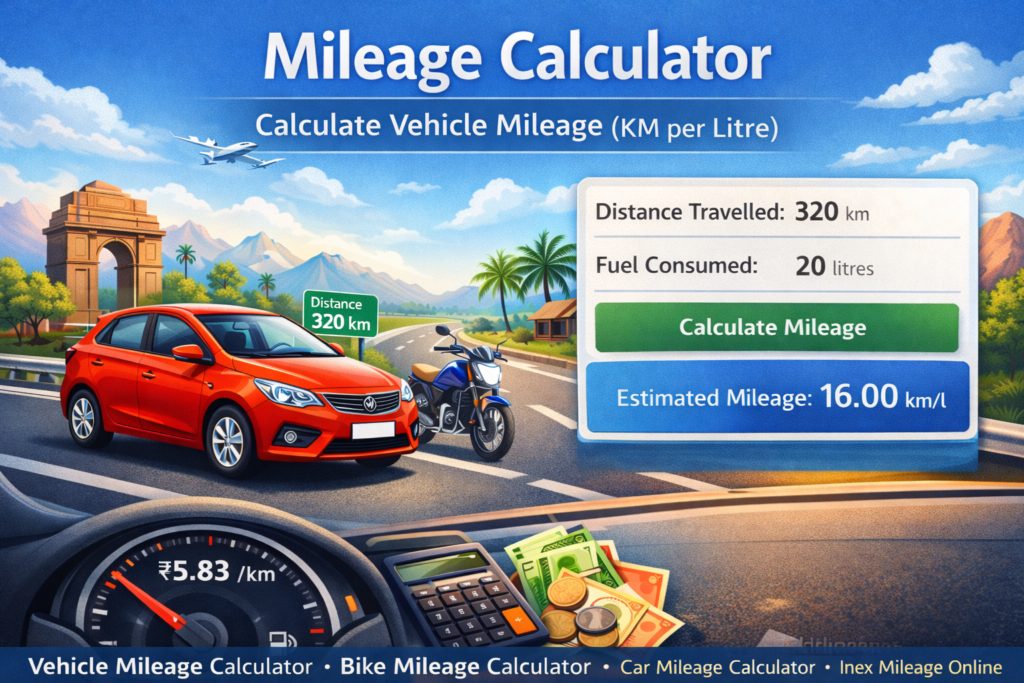
Want to know your car or bike’s actual mileage — commonly called vehicle average in India — not the number in the brochure, but what it really delivers on Indian roads? Our Mileage Calculator gives you the exact answer. Enter the distance you travelled and the fuel you used, and the calculator shows your real km per litre instantly — along with how it compares to the ARAI claimed figure and what it costs you per kilometre. Read on to understand how mileage is calculated, why your actual mileage is always lower than the company’s claim, and what you can do about it.
Mileage Calculator India
Calculate real km/l for car & bike · ARAI vs actual comparison
Mileage Calculator India 2026 – Real Fuel Efficiency for Car & Bike
Mileage is one of the first things Indian vehicle buyers check before making a purchase. And rightly so — with fuel prices staying high across most cities in 2025, the number of kilometres your vehicle covers per litre of fuel directly affects how much you spend every month.
But here is the problem: the mileage figure published by the manufacturer is an ARAI-certified number measured under ideal laboratory conditions. Your real-world mileage — calculated from actual driving on Indian roads — is almost always 10 to 20 percent lower. This gap is what leads to the very common complaint: ‘company ne 20 km/l boli thi, par mujhe sirf 14 mil raha hai.’
The Mileage Calculator on this page helps you find your actual mileage from real numbers — the kilometres you drove and the fuel you actually used. No guesswork, no estimates.
How Does the Mileage Calculator Work?
The mileage calculation formula is straightforward:
Mileage (km/l) = Distance Travelled (km) ÷ Fuel Consumed (litres)
Example: You drove 320 km and your vehicle used 22 litres of fuel.
- Mileage = 320 ÷ 22 = 14.54 km/l
- If petrol costs ₹103/litre, cost per km = ₹103 ÷ 14.54 = ₹7.08 per km
- Monthly fuel bill (800 km avg) = 800 ÷ 14.54 × 103 = ₹5,669
The calculator on this page does all three calculations together. It also compares your result against the ARAI claimed figure for your vehicle type and gives a rating — Excellent, Good, Average, or Poor — based on how your mileage compares to typical real-world ranges.
Two Methods to Calculate Mileage Accurately
Method 1 — Basic (Distance ÷ Fuel)
This is suitable when you know how much fuel your vehicle used over a specific distance. Enter the distance and fuel consumed. The calculator gives you km/l instantly. This method works well when your vehicle has a trip meter you can reset, or when you are calculating over a longer period using fuel bills.
Method 2 — Tank-to-Tank (Most Accurate)
This is the most accurate method used by automotive testers and experienced vehicle owners. Here is how to do it:
- Fill your fuel tank completely to the brim. Note the odometer reading (let’s call it Reading 1).
- Drive normally until the tank is close to empty or you want to measure again.
- Fill the tank to the brim again. Note how many litres were added (let’s call it Fuel Added) and the current odometer reading (Reading 2).
- Mileage = (Reading 2 − Reading 1) ÷ Fuel Added
The tank-to-tank method removes the error that can occur when a tank is not completely full. For the most reliable result, do this over at least 300 km of mixed driving.
ARAI Mileage vs Real World Mileage – What is the Difference?
ARAI stands for Automotive Research Association of India. It is the government body that certifies vehicle mileage before a model can be sold in India. The ARAI mileage figure is measured on a dynamometer (a machine that simulates driving) under tightly controlled conditions — no traffic, constant speed, fixed temperature, no AC, no load.
Real-world driving in India is the complete opposite of those conditions. Here is why the gap exists:
Factor | ARAI Test | Real India Driving |
Traffic | None | Heavy, stop-go |
Speed | Controlled 50-80 km/h | Varies 0-120 km/h |
Air Conditioning | Off | Usually on |
Vehicle Load | Driver only | Passengers + luggage |
Road Condition | Smooth test track | Potholes, gradients |
Tyre Pressure | Optimal | Often under-inflated |
The result is that real-world mileage is typically 10 to 20 percent lower than the ARAI figure. A car claimed at 20 km/l will realistically deliver 14 to 18 km/l depending on city and usage.
ARAI official website’ → https://araiindia.com
Typical Mileage by Vehicle Type in India (2026)
Vehicle Type | ARAI Range | Real-World Range | City vs Highway |
Petrol Hatchback | 18–24 km/l | 14–20 km/l | 12–17 / 18–22 |
Petrol Sedan | 16–21 km/l | 13–18 km/l | 11–15 / 16–20 |
Petrol SUV | 15–19 km/l | 12–16 km/l | 10–14 / 15–18 |
Diesel Car | 20–28 km/l | 16–22 km/l | 14–18 / 19–24 |
CNG Car | 24–32 km/kg | 20–28 km/kg | 18–24 / 24–30 |
Bike / Scooter | 40–65 km/l | 35–55 km/l | 30–45 / 45–60 |
What is a Good Mileage for Cars and Bikes in India?
Whether your mileage is ‘good’ or ‘poor’ depends on the type of vehicle. Here is a practical guide:
For Petrol Cars
- Excellent: Above 18 km/l — you are getting close to ARAI figures. Your vehicle is well-maintained and your driving habits are efficient.
- Good: 15 to 18 km/l — normal for city driving with moderate AC use.
- Average: 12 to 15 km/l — common in heavy city traffic. Consider tyre pressure check and service.
- Poor: Below 12 km/l — check air filter, spark plugs, and tyre pressure. Engine may need servicing.
For Bikes and Scooters
- Excellent: Above 55 km/l — very efficient. Ideal conditions or lightweight scooter.
- Good: 45 to 55 km/l — typical for well-maintained bikes.
- Average: 35 to 45 km/l — expected with regular city use.
Poor: Below 35 km/l — check air filter, chain tension, and tyre pressure for bikes. Scooters may need valve clearance adjustment.
8 Ways to Improve Your Vehicle's Mileage
- Check tyre pressure weekly — under-inflated tyres are the most common reason for poor mileage. Each tyre 4-5 PSI below the recommended level reduces mileage by 1-2 percent.
- Service on schedule — a dirty air filter alone can reduce mileage by up to 10 percent. Old engine oil increases friction. Stick to your service intervals.
- Use the right engine oil grade — using a heavier oil than specified increases internal resistance and reduces mileage. Check your owner’s manual for the correct viscosity (e.g. 5W-30 or 10W-40).
- Avoid warming up too long — modern fuel-injected engines do not need more than 30 seconds of warm-up time. Extended idling wastes fuel with zero km covered.
- Drive smoothly — anticipate traffic ahead and coast to slow down rather than braking hard. Aggressive braking wastes the kinetic energy you already paid for in fuel.
- Reduce AC load — park in shade, use ventilation to cool the cabin before switching on AC, and set temperature at 24-25°C rather than the lowest setting.
- Remove unnecessary weight — a roof carrier, full boot, or unused seats add rolling resistance. Every 50 kg of extra weight reduces mileage by 1-2 percent.
Check wheel alignment and balancing — misaligned wheels cause uneven tyre wear and increase rolling resistance. Get alignment checked every 10,000 km or after any kerb impact.
Mileage Calculator for Popular Indian Cars – Quick Reference
Car Model | Fuel | ARAI (km/l) | Real-World Avg (km/l) |
Maruti Swift | Petrol | 21.27 | 16–18 |
Hyundai i20 | Petrol | 20.35 | 15–17 |
Tata Nexon | Petrol | 17.01 | 13–16 |
Hyundai Creta | Petrol | 17.00 | 12–15 |
Honda City | Petrol | 18.40 | 14–17 |
Honda Activa 6G | Petrol | 60.00 | 45–52 |
Hero Splendor+ | Petrol | 60.00 | 50–55 |
Bajaj Pulsar 150 | Petrol | 49.50 | 42–48 |
ARAI figures are manufacturer-claimed. Real-world figures are based on owner-reported averages under mixed city and highway conditions.
You can also check our Fuel Cost Calculator and Vehicle Running Cost Calculator for more vehicle-related cost estimates.
Disclaimer
Frequently Asked Questions (FAQs)
Is this mileage calculator accurate?
Can I use this for bikes and scooters?
Should I calculate mileage in city or highway driving?
Does mileage change over time?
Is this an official mileage figure?
Final Words
This Mileage Calculator is a simple yet powerful tool to calculate mileage online accurately.
Whether you drive a car or ride a bike, knowing your vehicle mileage helps save fuel and money.
If you want better fuel efficiency, smarter driving decisions, and lower running costs, this vehicle mileage calculator is the perfect solution.
Frequently Asked Questions (FAQs)
How do I calculate mileage of my car or bike?
Fill the tank completely and note the odometer reading. Drive normally until the tank is near empty. Fill the tank again and note the litres added and the new odometer reading. Divide the distance covered by the litres added. That is your real mileage.
Why is my actual mileage lower than the ARAI claim?
ARAI mileage is tested under ideal conditions — no traffic, no AC, optimal temperature, no load. Indian city driving has traffic, AC usage, speed variations, and extra passengers. This is why real-world mileage is typically 10 to 20 percent lower than the ARAI figure.
What is a good mileage for a petrol car in India?
A mileage above 18 km/l is excellent for a petrol car. 15 to 18 km/l is good. 12 to 15 km/l is average. Below 12 km/l indicates something may need attention — check tyre pressure, air filter, and service history.
How do I improve my vehicle's mileage?
The most effective steps are: maintaining correct tyre pressure, servicing on schedule, driving smoothly without aggressive braking, reducing AC load, and removing unnecessary weight from the vehicle. Following these steps together can improve mileage by 15 to 20 percent.
Is CNG mileage calculated differently?
Yes. CNG mileage is measured in km per kg, not km per litre, because CNG is measured by weight. A CNG car with 24 km/kg mileage will travel 24 km per kilogram of CNG consumed. The Mileage Calculator on this page supports CNG vehicles — just select CNG Car from the vehicle type dropdown.
Can I use this mileage calculator for bikes?
Yes. The calculator works for all two-wheelers — bikes, scooters, and mopeds. Select Bike/Scooter from the vehicle type dropdown. Typical real-world bike mileage is 35 to 55 km/l. The calculator compares your result against these benchmarks and shows a rating